
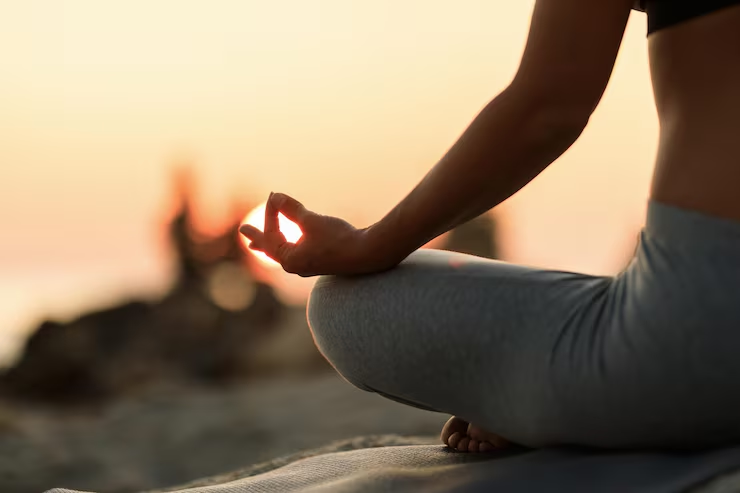
What is meditation?
Meditation is a practice of training the mind to focus ones thoughts. To redirect thoughts, aiming for emotional calm, clarity of the mind, and stability of the body. It can aid in reducing stress and improving well-being.
There are religious groups that utilize meditation as a part of their practice. But I would like to focus on meditation itself, vs. the religious aspect for the sake of this writing.
Why do people meditate?
For a variety of reasons: religion; spiritual; relaxation; reducing anxiety; to communicate with spirits; to get in touch with yourself on a deeper level; to connect with past lives; the answer is endless.
Finding calm is a gateway into starting meditation for a lot of busy people. Meditation is not about turning off ones thoughts and emotions, but observing ones thoughts, without judgment. It’s a solitary activity (you can do group meditations, however, what is revealed during a meditation, is for you alone and no one else, unless you wish to disclose it to someone). Busy people, with stressful lives, often turn to meditation to give themselves a chance to regroup and recenter themselves when their days are becoming too chaotic.
Some people find that they would like to be more present or mindful, and use meditation as a way to stay grounded and grateful for their current situations.
Others may find themselves meditating to work on focus or attention. Choosing to use their time with one single thought or problem they have been struggling with to attempt to see if any resolution comes to them.
Regardless of the specific reason, there are many benefits to meditation when you begin a regular practice: reduction of cortisol levels and calming the nervous system, thereby reducing stress levels; improving sleep, lowering blood pressure, and strengthening immune function; enhancing memory and concentration, improving mood and self-esteem; increased focus and self-awareness – just to name a few.
What is an easy way to start meditating?
There are dozens if not hundreds of guided meditations on Youtube and other platforms online. I personally use an app on my phone called Insight Timer (there is a free version that has a plethora of content, but their paid subscription has so much additional content that it’s worth the price if you are truly interested in meditation.)
If you aren’t interested in a guided experience: find a quiet, comfortable sitting or laying position; you can simply put on some soft music (without lyrics), close your eyes, and just begin breathing deeply (In through your nose, holding for a couple of seconds, and then exhaling slowly out of your mouth). Then just start noticing your different body parts, starting from your toes and working your way up to your head. Internally telling each one to relax. Example: Notice your toes, notice how they feel. Are there any aches or pains? Relax the tension from your toes. Move into your feet. Notice how your feet feel. Are there any aches or pains? Release the tension from the day. Move onto your ankles. How do they feel? Etc. (slowly, being very mindful of each body part and how they feel, what any aches and pains feel like if you have any. Can you specifically tell what kind of pain it is, or what it might be caused from? Are you able to relax the tension when you tell it to relax?).
If you fall asleep during the meditation, that’s fine.
If your mind wanders during the meditation, that’s fine – once you realize you aren’t thinking about the task at hand, redirect it back. Don’t focus on your mind drifting, and don’t start the process over. You want to be intentional and mindful with the process, but also not restrictive of yourself. There’s no judgements. This is your meditation. If you forget a body part, or think it feels silly there’s no one else that has to know about it. The only one who is not benefiting from the meditation is you.
**You might want to rethink starting a meditation if you are in a time crunch, or looking for the end of the session. If you would rather be anywhere other than the meditation, you will be thinking of anything other than focusing on the meditation. You won’t find benefit in meditation from being constrained to a deadline for your meditation.
Should you use a “Mantra” when meditating?
A Mantra is a repetitive word or phrase (much like a chant) that assists in helping the person who is meditating get into a relaxed and deep meditative state. Mantras are a sacred word or sound. Generally mantras are energetic in nature and carry a vibrational signature.
A stereo-typical phrase or sound that tv shows often portray when someone is meditating is the sound of “Om” or “ohm”. Which is a mantra.
“Om” specifically is a sacred sound and symbol found in Hinduism and Buddhism and used in Yoga. It is also used in Karuna Ki Reiki. It represents the entire universe, and it’s said to be the source of all creation. Om represents the eternal oneness of all that is.
So, while using mantra’s while meditating can be a good thing, it’s generally beneficial to pick a sound or phrase that resonates with the meaning or intention behind the reason you are meditating, instead of picking a default sound.
If you are not familiar with mantras, you can utilize an intention while meditating. An intention is a purpose or a desired outcome of how you wish a perceived event will turn out, or how you hope your meditation will guide you. For example, if you are having a particularly difficult time at work on a project and you don’t know how to resolve an issue, maybe with a co-worker, you could set an intention before you begin to meditate that you would like a positive resolution with your coworker. You could say it a few times: “I would like a positive resolution with my co-worker (insert name here).”, “I would like a positive resolution with my co-worker (insert name here).”, “I would like a positive resolution with my co-worker (insert name here).”; and then focus your meditation on the project that you are working on. Maybe focus on the name of the project, or key aspects of it that you are confident in. Maybe if there is a workflow that is giving you issues, try to focus on that. Often, during meditations, you may hear a voice that says something, and it might sound like your own voice. Don’t disregard this voice or the answers it provides. I’m not here to tell you who that voice is, or what it represents – I will leave that up to you to decide for yourself – but the answers you seek during meditation are often the correct ones.
There is a lot more to meditation that I won’t delve into here, from religious aspects to yoga usage; to it being used to “time travel” and accessing the Akashic records. Meditation is truly amazing. I, personally, first did a meditation with a friend when I was a pre-teen and didn’t realize it was a meditation (it was on cassette tape). Later in my 20’s I attempted meditation again and couldn’t focus my mind, and assumed it wasn’t for me. It took a lot of practice. A lot of sitting in silence and thinking, then trying again. If you want to do it, there’s a meditation out there for you. You just have to find the right one that will work for you.